
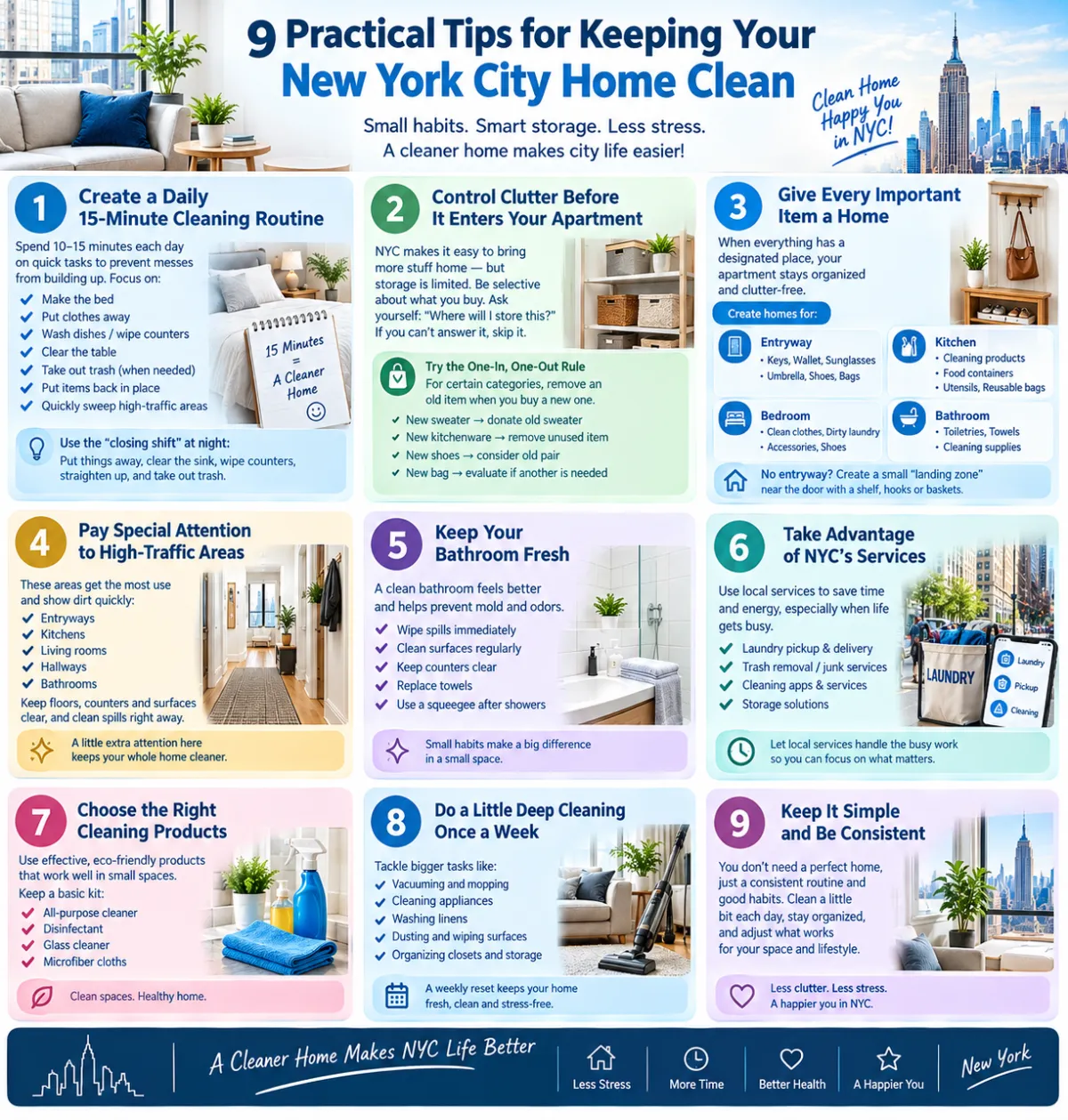
9 Practical Tips for Keeping Your New York City Home Clean
Keeping a home clean in New York City can feel like a full-time job. Between busy work schedules, small apartments, crowded streets, limited storage, roommates, pets, and the constant flow of people in and out of the building, NYC homes can accumulate clutter and dirt surprisingly quickly.
The good news is that keeping your apartment clean does not require spending every weekend scrubbing floors. A consistent routine, smart storage, and a few practical habits can make a major difference.
Whether you live in a Manhattan studio, a Brooklyn brownstone, a Queens apartment, a Bronx rental, or a Staten Island home, these nine tips can help you create a cleaner, more comfortable living space.
1. Create a Daily 15-Minute Cleaning Routine
One of the easiest ways to keep your NYC home clean is to stop thinking of cleaning as one enormous weekend project.
Instead, spend about 15 minutes each day handling the tasks that prevent messes from accumulating.
Your daily routine might include:
Making the bed.
Putting clothes away.
Washing or loading dishes.
Wiping kitchen counters.
Clearing the dining table.
Taking out trash when necessary.
Returning misplaced items to their proper locations.
Quickly sweeping visible dirt from high-traffic areas.
Fifteen minutes may not sound like enough time to clean an entire apartment, but the goal is not to deep-clean everything. The goal is to prevent small messes from becoming large ones.
This approach is particularly useful in NYC apartments because smaller spaces can look cluttered very quickly. A few items left on a countertop or floor may have a much greater visual impact in a studio or one-bedroom apartment than they would in a large suburban house.
Try the "closing shift"
Before going to bed, imagine that you are closing a small restaurant.
Put everything back where it belongs.
Clear the sink.
Wipe the kitchen counter.
Put away food.
Straighten the living room.
Put dirty clothes in the hamper.
Take out trash if necessary.
When you wake up, your apartment will already feel significantly more organized.
2. Control Clutter Before It Enters Your Apartment
One of the biggest challenges of keeping a New York City home clean is not dirt—it's stuff.
NYC residents have access to virtually everything imaginable. Online shopping, takeout deliveries, clothing stores, convenience stores, specialty shops, and countless services make it incredibly easy to bring more possessions into your home.
The problem is that NYC apartments often have limited storage.
The solution is to become more selective about what enters your home.
Before buying something, ask yourself:
Where will I store this?
If you cannot answer that question, consider whether you really need the item.
This is especially important for inexpensive purchases. A $10 item may seem insignificant, but dozens of inexpensive purchases can eventually fill an entire closet.
Adopt a one-in, one-out rule
For certain categories, consider removing an old item whenever you purchase a new one.
For example:
Buy a new sweater → donate an old sweater.
Buy new kitchenware → remove something you rarely use.
Buy new shoes → consider whether an old pair should go.
Buy a new bag → evaluate whether another bag is still necessary.
The objective isn't minimalism for its own sake. The objective is to make sure your possessions remain manageable within the amount of space you actually have.
3. Give Every Important Item a Home
A clean apartment is much easier to maintain when everything has a designated location.
Without a designated location, objects tend to migrate.
Keys end up on the kitchen counter.
Mail ends up on the dining table.
Shoes end up beside the couch.
Charging cables end up everywhere.
Laundry ends up on a chair.
Eventually, the apartment looks messy even though none of these individual problems seems significant.
Create specific homes for frequently used items.
For example:
Entryway
Keys
Wallet
Sunglasses
Umbrella
Shoes
Bags
Kitchen
Cleaning products
Food storage containers
Cooking utensils
Reusable shopping bags
Bedroom
Clean clothes
Dirty laundry
Accessories
Shoes
Bathroom
Toiletries
Towels
Cleaning supplies
If you live in a small apartment without a traditional entryway, create a small "landing zone" near the door using a narrow shelf, hooks, baskets, or another compact organizational solution.
The easier it is to put something away, the more likely you are to actually do it.
4. Pay Special Attention to High-Traffic Areas
New York City generates a lot of foot traffic.
You may walk several blocks to the subway, visit restaurants and stores, walk through busy sidewalks, and then bring whatever accumulated on your shoes back into your home.
That makes floors and entry areas especially important.
Create a simple entry routine.
When you come home:
Remove your shoes.
Put them in their designated location.
Hang up your coat.
Put your bag away.
Put keys and other small items in their designated spot.
Wash your hands.
Deal with mail and packages rather than allowing them to accumulate.
A washable mat near the entrance can also help capture some dirt before it spreads throughout the apartment.
Clean according to traffic
Not every part of your home needs the same cleaning frequency.
High-traffic areas generally deserve more frequent attention than rooms or corners that are rarely used.
For many households, that means paying particular attention to:
Entryways
Kitchen floors
Bathroom floors
Areas around dining tables
Frequently used living spaces
Rather than automatically cleaning the entire apartment at the same frequency, focus your effort where dirt and clutter actually accumulate.
5. Keep Your Kitchen Clean Every Day
A dirty kitchen can make an otherwise clean apartment feel messy.
The kitchen is also one of the easiest areas to keep under control if you establish a few simple rules.
Don't let dishes accumulate
Try to wash dishes or load the dishwasher soon after eating.
A sink filled with dishes can quickly make the entire kitchen feel chaotic.
Wipe counters regularly
After preparing food, wipe the surfaces you used.
This takes much less time when spills and crumbs are fresh.
Clean as you cook
Instead of waiting until dinner is finished, wash or put away items while food is cooking.
For example, while water is boiling or something is baking, you can:
Put ingredients away.
Rinse utensils.
Wipe counters.
Load the dishwasher.
Throw away packaging.
Check your refrigerator
NYC apartments often have smaller refrigerators, which can become disorganized quickly.
Once a week, check for:
Expired food
Forgotten leftovers
Produce that needs to be used
Spills
Containers that should be washed
A few minutes of refrigerator maintenance can prevent unpleasant odors and unnecessary food waste.
6. Make Laundry Easier to Manage
Laundry can become especially challenging for NYC residents who use shared laundry rooms, laundromats, or facilities elsewhere in their buildings.
The key is to prevent laundry from becoming a giant pile.
Use a hamper or laundry basket with a specific location.
Don't allow clothing to accumulate on the floor.
If your household has multiple people, consider separate hampers or compartments for different categories.
Establish a predictable laundry schedule
Rather than waiting until every piece of clothing is dirty, establish a routine.
For example:
One day for everyday clothing.
One day for towels and linens.
One day for larger household items, when necessary.
The exact schedule depends on your household.
If you use a laundromat, combine laundry with another regular activity. You might bring something to read, answer emails, or use the time to plan your week.
The goal is to turn laundry into a predictable household task instead of an emergency.
7. Clean Your Bathroom Before It Becomes Difficult
Bathrooms generally require frequent attention because moisture, soap residue, hair, and everyday use can quickly create buildup.
Fortunately, regular small cleanups are much easier than occasional major cleaning sessions.
After showering, allow surfaces to dry properly and address visible water or soap buildup when appropriate.
Keep basic cleaning supplies accessible.
A simple bathroom routine might include:
Daily or frequent tasks
Hang towels properly.
Put toiletries away.
Remove visible hair.
Wipe frequently used surfaces.
Weekly tasks
Clean the sink.
Clean the toilet.
Clean the shower or tub.
Clean the mirror.
Mop or clean the floor.
Occasional tasks
Wash shower curtains or liners as appropriate.
Clean grout.
Clean ventilation areas.
Declutter cabinets.
Dispose of expired products.
Keeping supplies close to the bathroom can reduce the psychological barrier to cleaning. If you have to search through three closets for a cleaning product, you're less likely to use it immediately.
8. Use a Weekly Reset Instead of a Massive Cleaning Day
Daily maintenance handles small problems. Your weekly reset handles everything that accumulated during the week.
Choose a consistent day and spend approximately 30–90 minutes, depending on the size of your home and household.
Your weekly reset might include:
Vacuuming or sweeping.
Cleaning bathroom surfaces.
Changing bedding.
Dusting.
Mopping where needed.
Emptying garbage.
Cleaning kitchen surfaces.
Checking the refrigerator.
Organizing clutter.
Sorting mail and paperwork.
Restocking household supplies.
Don't feel obligated to complete every possible cleaning task every week.
Instead, create a priority list.
Example NYC apartment weekly reset
Priority 1: Kitchen
Clean counters, sink, stovetop, dishes, and refrigerator leftovers.
Priority 2: Bathroom
Clean toilet, sink, mirror, shower or tub, and floor.
Priority 3: Floors
Vacuum or sweep the areas that receive the most traffic.
Priority 4: Bedroom
Change bedding, put away clothing, and clear surfaces.
Priority 5: Living area
Return items to their homes and dust frequently used surfaces.
This system makes cleaning manageable because you're dealing with a week's worth of maintenance rather than months of accumulated mess.
9. Build a Cleaning System That Fits Your NYC Lifestyle
The most important cleaning tip is to build a system you can actually maintain.
There is no universal cleaning schedule.
A single person living in a studio has different needs from a family living in a three-bedroom apartment.
A person who works from home has different cleaning patterns from someone who spends most of the day outside.
A household with pets has different needs from a pet-free household.
And a person living in a walk-up has different practical considerations from someone living in a large apartment building.
The best system is therefore not the one that looks most impressive on paper. It is the one you will continue using.
Consider your apartment's specific challenges
Ask yourself:
Where does clutter accumulate?
Where does dirt enter the home?
Which room becomes messy first?
Which tasks do I consistently avoid?
Which items never seem to have a home?
Where do packages accumulate?
How often should I handle laundry?
Which cleaning supplies do I actually use?
Then design your routine around those answers.
A Simple NYC Cleaning Schedule
Here's an example of a manageable schedule for a busy New York City resident.
Every day
Spend approximately 10–15 minutes on:
Dishes
Kitchen counters
Clothes
Trash as needed
Clutter
Quick bathroom or floor cleanup when necessary
Once or twice a week
Handle:
Vacuuming or sweeping
Bathroom cleaning
Bedding
Dusting
Mopping where appropriate
More thorough kitchen cleaning
Every few weeks
Consider:
Cleaning the refrigerator
Cleaning less frequently used surfaces
Organizing closets
Cleaning under furniture
Reviewing accumulated paperwork
Decluttering drawers
Seasonally
Review:
Clothing
Storage areas
Kitchen cabinets
Bathroom products
Cleaning supplies
Items you no longer use
Make Cleaning Easier With Better Organization
Cleaning and organization are closely connected.
If your apartment has an organizational problem, repeatedly cleaning the same clutter may not solve the underlying issue.
Consider using vertical space where appropriate.
New York City apartments often have limited floor space, so walls, doors, shelves, and the space underneath furniture can become valuable storage areas.
Useful organizational categories can include:
Entryway storage
Under-bed storage
Closet organizers
Drawer dividers
Baskets
Shelves
Hooks
File organizers
Kitchen cabinet organizers
However, avoid buying organizational products simply because they look useful.
An organizer is still another object in your apartment.
First decide what you need to store. Then choose the simplest solution that fits the space.
Don't Forget About Air and Dust
Urban living can introduce dust and outdoor particles into your home.
Regular dusting can help keep surfaces cleaner, particularly around:
Window sills
Shelves
Electronics
Baseboards
Furniture
Bedroom surfaces
Ventilation and air quality also matter to overall comfort. Follow the maintenance recommendations for your building and any heating, cooling, or ventilation equipment you use.
If you have an air purifier, clean or replace its filter according to the manufacturer's instructions.
Be Careful With Cleaning Products
More cleaning product does not necessarily mean a cleaner home.
Follow the manufacturer's instructions for each product and avoid mixing cleaning chemicals unless the manufacturer explicitly says they can be combined.
In particular, never casually mix household cleaning chemicals. Some combinations can produce dangerous fumes.
Keep cleaning products stored safely and appropriately, particularly if children or pets live in the home.
What to Do When Your Apartment Gets Very Messy
Everyone occasionally falls behind.
A busy week, illness, travel, work deadline, move, or unexpected event can leave an apartment significantly messier than usual.
Don't try to clean everything simultaneously.
Instead, use a reset sequence.
Step 1: Remove garbage
Walk through the apartment with a garbage bag and collect obvious trash.
Step 2: Collect dishes
Bring dishes to the kitchen.
Step 3: Collect laundry
Put dirty clothes in the hamper.
Step 4: Put obvious items away
Return objects to their normal locations.
Step 5: Clear major surfaces
Focus on counters, tables, desks, and other visible surfaces.
Step 6: Clean the kitchen
Wash dishes and wipe counters.
Step 7: Clean the bathroom
Focus on the toilet, sink, shower or tub, and floor.
Step 8: Clean floors
Vacuum, sweep, or mop according to the flooring and manufacturer's recommendations.
The key is to restore basic order first. Once the apartment is functional again, deeper cleaning becomes much easier.
Living With Roommates
Roommates can make cleaning either easier or harder.
The biggest issue is often unclear responsibility.
Instead of saying, "We should clean more," establish specific responsibilities.
For example:
TaskPerson APerson BPerson CKitchen✓Bathroom✓Floors✓Trash✓Shared supplies✓
Rotate responsibilities if everyone wants an equal division of work.
Also distinguish between personal mess and shared responsibilities.
A roommate's bedroom may be their responsibility, while the kitchen, bathroom, hallway, and living room are shared responsibilities.
Clear expectations prevent small disagreements from becoming larger conflicts.
Living With Pets in NYC
Pets can add additional cleaning responsibilities.
Depending on the animal, you may need to pay more attention to:
Fur
Litter
Food areas
Water spills
Bedding
Outdoor dirt
Odors
Place cleaning supplies where messes actually occur.
For example, if your pet frequently tracks dirt near the entrance, keeping an appropriate towel or cleaning tool nearby can make cleanup easier.
Wash pet bedding according to the manufacturer's instructions and maintain litter or feeding areas regularly.
The Most Important Rule: Clean Small Messes Early
A small spill is usually easy to handle.
A stain that has been sitting for days can be much harder.
A few dishes are manageable.
A sink full of dishes plus food residue is more work.
A few pieces of clothing are easy to put away.
A bedroom covered in laundry is a project.
This leads to a simple principle:
Handle small messes before they become large messes.
You don't need to clean constantly. You simply need to recognize which problems become significantly harder when ignored.
Your apartment doesn't need to be perfect.
It needs to be functional, comfortable, and manageable.
By dealing with small messes regularly, limiting unnecessary clutter, using your available storage intelligently, and creating a routine that fits your schedule, you can keep your NYC home substantially cleaner without turning your entire life into a cleaning project.

©
Fancy Cleaning Blog
9 - Tips for Keeping Your New York City Home Clean
Copyright Fancy Cleaning 2026. All rights reserved
Terms & Conditions - Privacy Policy - Contact
Powered by MeshOps.ai
Testimonials

John Doe
Lorem ipsum dolor sit amet, consectetur adipiscing elit, sed do eiusmod tempor incididunt ut labore et dolore magna aliqua. Ut enim ad minim veniam, quis nostrud exercitation ullamco laboris nisi ut aliquip ex ea commodo consequat.


Jane Doe
Lorem ipsum dolor sit amet, consectetur adipiscing elit, sed do eiusmod tempor incididunt ut labore et dolore magna aliqua. Ut enim ad minim veniam, quis nostrud exercitation ullamco laboris nisi ut aliquip ex ea commodo consequat.